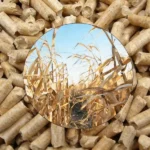
Every year, the world generates billions of tonnes of agricultural residue — wheat straw, rice husk, corn stalks, sugarcane bagasse, cotton stalks, sunflower hulls — and the vast majority of it is either burned in fields or simply left to decompose. Both outcomes represent a massive waste of energy and a significant source of carbon emissions.
Agricultural residue pellets produced an average energy content of around 15 MJ/kg — comparable to low-grade coal and significantly superior to unprocessed raw straw — at a raw material cost 10 to 15% below wood pellets in regions where agricultural waste is abundant. India alone generated 774 million tonnes of crop residue per year, of which 228 million tonnes represents a commercially exploitable surplus (MNRE). This is the feedstock opportunity that the best agricultural pellet machine manufacturers are built to capture.
Agricultural residues are not wood. They behave very differently inside a pellet mill. Low lignin content means the feedstock cannot self-bind easily — natural lignin acts as the glue in wood pelleting, and when it is absent or minimal (as in straw and rice husk), the pelleting process requires higher compression pressure, careful conditioner temperature management, and often the addition of a natural binder such as starch.
High silica content in rice husk — reaching 18% in some clean rice straw varieties — is highly abrasive and destroys standard ring dies within a fraction of their normal lifespan. Moisture content in field-collected residues frequently exceeds 20 to 30%, requiring integrated drying before pelleting. These are not generic pellet machine challenges. They require machines engineered specifically for agricultural feedstocks, and not every manufacturer has solved them.
The 5 Concerns Every Agricultural Pellet Machine Buyer Has
“Will my ring die last?” Agricultural residues — particularly rice husk with 18% silica content and abrasive crop stalks — destroy standard ring dies far faster than wood. A die made from standard 40Cr steel may last 200 to 300 hours on straw versus 800 to 1,000 hours on sawdust. Buyers should demand dies made from 42CrMo alloy steel with a hardness of 60HRC or higher, and manufacturers who have confirmed straw pelleting reference projects — not just lab specifications.
“Will my pellets hold together?” Straw and rice husk have low lignin content and high fiber content, making them harder to bind into durable pellets. Agricultural pellets must achieve durability of 97% or higher for commercial sale. This requires a conditioner that raises material temperature to 60 to 80°C to activate lignin and natural sugars, and sometimes an external binder. Manufacturers who understand agricultural feedstock chemistry — not just machine specifications — are the ones who deliver durable pellets consistently.
“My straw is too wet — what do I do?” Field-collected agricultural residues typically arrive at 20 to 35% moisture content. Pelleting requires feedstock at 12 to 15%. This means the drying system is not optional — it is as critical as the pellet mill itself. Buyers must evaluate complete production line solutions, not just the mill. Manufacturers who offer integrated hammer mills, rotary drum dryers, and pellet coolers as a matched system give operators a single point of accountability for the entire process.
“My available crop residue changes by season.” Wheat straw is available post-harvest. Rice husk runs year-round from mills. Corn stalks peak in autumn. Operators who rely on a single agricultural feedstock face seasonal shortages that idle their lines. The best agricultural pellet machine manufacturers build machines with adjustable compression ratios and interchangeable ring dies that allow switching between straw, husk, stalks, and even wood sawdust — so your plant runs 12 months a year on whatever is cheapest and most available.
Rice husk collected near a mill can cost $5 to $15 per ton in South Asia and Southeast Asia. Wheat straw runs $20 to $45 per acre yield in North America and Europe. At a finished pellet selling price of $60 to $120 per ton for agricultural-grade biomass fuel, and production cost of $35 to $65 per ton for a well-run agri-residue line, the margin opportunity is real — but only if the machine runs reliably, consumes energy efficiently, and keeps maintenance costs low. A 3 t/h straw pellet line producing 18,000 tonnes per year at a $40 per ton margin generates $720,000 in gross annual return. At a $200,000 line investment, that is a payback period under 12 months in the best cases, and 2 to 3 years in typical scenarios.
Biomass pellets market projected by 2035 (Future Market Insights, 6.7% CAGR). Agricultural residue pellets are the fastest-growing product type within this total.
Global agricultural residue pellet production volume forecast by 2031 (Mordor Intelligence), growing at 7.2% CAGR — faster than the wood pellet segment.
India’s Ministry of Power mandate: coal-fired plants co-fire 5% biomass pellets from FY 2024–25, rising to 7% from FY 2025–26. This creates binding, predictable demand for agricultural pellet producers.
Agricultural residue and waste held 38.5% of the global biomass pellets market by source in 2024 — the largest single feedstock category, ahead of virgin lumber and forest waste.
India’s estimated pellet-based electricity generation potential from agricultural and forestry residues (IEA techno-economic study), backed by a 244 TWh production forecast by 2030.
Agricultural residue pellets contributed over 7 million tonnes to global production in 2023, with India alone producing over 3 million tonnes primarily for industrial use and rural heating.
The Manufacturers That Focus on Agricultural Pellet Machines
The Future of Agricultural Pellet Machines: Five Trends That Will Define the Decade
India’s Ministry of Power has mandated coal plants co-fire 5% biomass from FY2024-25, rising to 7% from FY2025-26. With 774 million tonnes of crop residue generated annually and 228 million tonnes in exploitable surplus, India is creating a captive, policy-driven market for agricultural pellet machines at scale. The IEA estimates a 35 GW pellet-based electricity potential from agri-residues alone. World Bank-backed rural energy programs are driving decentralized pellet production at village level through Farmer Producer Organizations (FPOs). Equipment suppliers positioned in India with local certifications and service infrastructure will disproportionately capture this growth.
The commercialization of steam-treated and torrefied agricultural pellets — exemplified by the Valmet/Wilhelmina TG2 collaboration (May 2025) — addresses the biggest technical barrier to agricultural residue pellets at utility scale: high potassium content causing boiler slagging. Steam explosion treatment neutralizes potassium, raises energy density from 15 MJ/kg to 18 to 20 MJ/kg, and enables co-firing ratios previously impossible with raw straw pellets. This opens the full utility co-firing market to agricultural pellets, not just the heating and small industrial segments. Manufacturers with machines capable of processing both standard and steam-pretreated agricultural feedstocks will be structurally advantaged.
In 2023, over 1.8 million tonnes of verified carbon offsets were linked to biomass pellet projects worldwide, with projects in Thailand, South Africa, and Brazil securing credits for switching from fossil fuels to pellets in heat-intensive industries. Agricultural residue pellets — particularly those replacing in-field burning of straw, which is a significant air pollution source across India, China, and Southeast Asia — generate both carbon credits and regulatory compliance value simultaneously. This dual revenue stream (pellet sales + carbon credits) is improving the economics of agricultural pellet lines beyond what the feedstock and fuel price spread alone would suggest.
The logistics cost of transporting bulky, low-density agricultural residues to centralized pelleting facilities is a major barrier to profitability. The solution being adopted across India (through MNRE’s SAMARTH Mission and EPC Fund grants), Southeast Asia, and parts of Eastern Europe is decentralized, village-level or farm-cluster-level pelleting — small machines of 0.5 to 3 t/h deployed near the residue source. Manufacturers offering compact, robust, affordable agricultural pellet machines at the 0.5 to 3 t/h scale — particularly those with flat-die designs suited to fibrous feedstocks — will serve this rapidly growing decentralized segment. RICHI’s MZLH series, Buschhoff’s mobile flat-die systems, and GEMCO’s entry-level straw mills all serve this market.
Using locally sourced agricultural residues — sawdust, bark, rice husk, straw — has already reduced raw material costs by 20% in some markets compared to wood chip feedstocks (Market Reports World, 2024). As pelleting technology improves — specifically machines that handle higher silica content, variable moisture, and low-lignin binding challenges — the cost of producing agricultural pellets will continue declining. Meanwhile, agricultural residue pellet prices are rising in supply-constrained markets: rice husk pellet prices increased 18% in India in 2023 due to seasonal scarcity, demonstrating that demand can outpace supply even in regions with enormous feedstock bases. This combination — lower production cost, higher market price — is compressing payback periods and improving the financial case for investment in specialized agricultural pellet machines.
Which Agricultural Pellet Machine Manufacturer Is Right for You?
No other manufacturer serves as wide a range of confirmed agricultural feedstocks as RICHI Machinery — 12 or more crop types, straw-specific output of 3 to 12 t/h, and 140-plus country reach at 30 to 50% below Western OEM pricing. For European residential straw pelleting, La Meccanica and Buschhoff offer flat-die expertise and heritage certifications. For large-scale North American and European operations where energy efficiency is the primary KPI, CPM’s 17% global market share, 240,000 kWh per mill annual savings, and FutureMetrics-endorsed PM1200DD make it the strongest commercial validation. For utility-scale industrial co-firing from agricultural residues at the highest capacity levels, ANDRITZ’s 98% uptime guarantee and 350-plus reference plants are unmatched.
Future Market Insights: Pellet Machine Market 2025–2035 ($2.5B→$3.8B, CAGR 4.4%); Biomass Pellets Market 2025–2035 ($23.5B by 2035, CAGR 6.7%) · Market.us: Biomass Pellets Market (Agricultural Residue & Waste 38.5% share, 2024; India mandate 5%→7%) · Mordor Intelligence: Wood Pellet Market agricultural residue segment 7.2% CAGR to 2031; 12M tonnes forecast 2031 · Allied Market Research: Biomass Pellets Market $9.5B (2023) → $16B (2033) · SkyQuest: Biomass Pellets Market $9.03B (2023) → $15.38B (2032, CAGR 6.1%) · IndustryARC: Biomass Pellets Market $19.3B by 2031 (CAGR 8.2%) · Market Reports World: Agricultural residue pellets 7M+ tonnes global production 2023; India 3M+ tonnes; 20% raw material cost reduction from local sourcing; rice husk prices +18% India 2023 · Straits Research: Biomass Pellets Market $16.27B by 2033 (CAGR 6.04%); TSPL torrefied bio-pellet plant Punjab India (April 2025) · Valmet / Wilhelmina: TG2 steam-treated biomass pellets announcement (May 2025) · MNRE India: 774 MT annual crop residue; 228 MT exploitable surplus; SAMARTH Mission; EPC Fund guidelines · IEA: India biomass-pellet electricity potential 35 GW; 244 TWh by 2030; modern bioenergy 6% global energy supply · RICHI Machinery: pellet-richi.com (straw pellet machine 3–12 t/h); richipelletizer.com (MZLH agricultural series); cn-pellet.com (agricultural feedstock project database) · GEMCO Energy: gemcopelletmills.com (crop residue pellet mill guide); gemco-energy.com (straw pellet machine product page) · La Meccanica: biopelletmachines.com profile (30–75 kW flat-die specifications) · Buschhoff: mobile flat-die 500–1,200 kg/h specification · Pellet Machine Maker: Global Trends in Biomass Pellet Machine Manufacturers 2024–2035 (September 2025) — RICHI 8–10% market share · 24 Market Reports: Biomass Pellet Machine Market — flat-die 61% market share dominance; agricultural waste installations +19% in fertilizer processing