Could Sawdust Become More Than a Waste Product?
Woodworking businesses often deal with a familiar problem: large volumes of sawdust and small wood residues are generated every day, yet the material may have limited value in its original form.
Some factories sell sawdust as boiler fuel or bedding. Others simply pay to move it away.
But what happens when that same material is processed into a finished pet-litter product?
The idea is increasingly interesting for businesses that already operate in the wood industry. A sawmill, furniture factory or wood-panel producer may already have the most important ingredient: a steady supply of woody biomass.
The challenge is developing a process that turns irregular wood residues into a standardized consumer product.
That is where a complete Sawdust Cat Litter Machine setup becomes different from ordinary biomass processing equipment. The goal is not merely to densify sawdust. The goal is to create a product that performs consistently in real household use.
The First Question: Is Every Type of Sawdust Suitable?
No.
The source of the sawdust matters.
Clean woodworking sawdust is usually easier to process than mixed waste from construction demolition or contaminated wood streams. Manufacturers should pay particular attention to paint, adhesives, preservatives, soil, plastic and other unwanted materials.
A pet-litter production project should begin with a clear raw-material policy.
Suitable feedstock may include clean residues generated from:
- Furniture manufacturing
- Sawmills
- Wood cutting
- Planing operations
- Cabinet production
- Other clean wood-processing activities
The exact material specification depends on the product and market.
Raw material that is inconsistent at the beginning will create more problems later, no matter how advanced the machinery is.
What If the Material Is Too Coarse?
This is common when a factory produces a mixture of sawdust and small wood chips.
Larger particles may need to be reduced before forming.
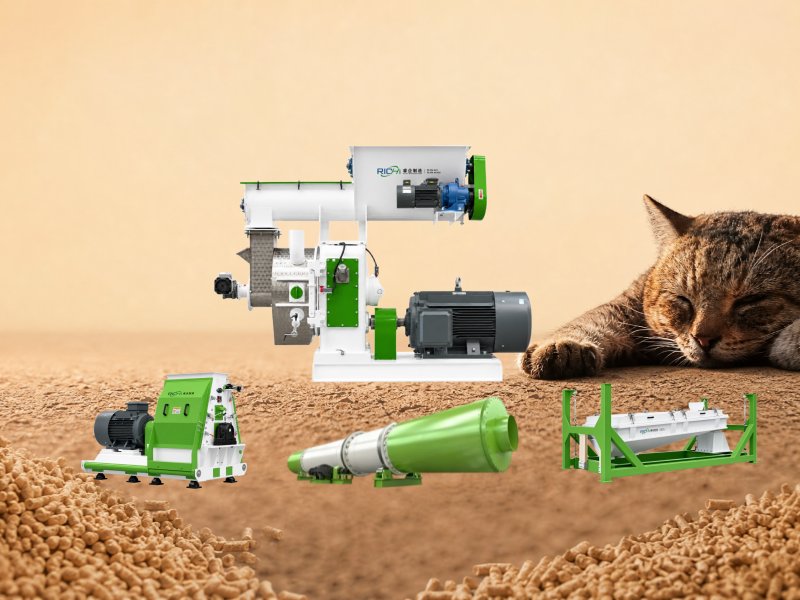
A commercial wood chip hammer mill for sale can be considered when incoming material includes chips that are too large or irregular for direct processing.
Hammer milling creates a more uniform material stream and helps the downstream forming equipment operate more consistently.
However, the goal should not be excessive grinding.
Too much grinding can:
- Increase power consumption
- Produce unnecessary fines
- Reduce material efficiency
- Increase dust-handling requirements
Good size reduction is about achieving a useful particle distribution, not simply producing the smallest possible powder.
Does a Woodworking Factory Need a Completely New Production Facility?
Not necessarily.
One of the interesting aspects of sawdust-based cat litter is the possibility of reusing part of an existing industrial site.
A woodworking company may already have floor space, electrical infrastructure, storage areas and material-handling equipment.
The new production section may therefore be organized as a downstream processing system.
A simplified layout could look like this:
Wood residue collection → raw-material storage → screening or pre-cleaning → milling → moisture adjustment → forming → drying → cooling → final screening → packaging → finished-product storage.
The exact layout depends on the site.
For example, if the wood factory already produces fine, dry sawdust, the initial processing section can be relatively simple.
If it generates wetter material and a high percentage of chips, more preparation capacity is required.
The Role of the Forming Stage
Once the raw material is prepared, it needs to be transformed into a suitable litter particle.
This stage determines the general shape and density of the finished material.
A biomass pellet maker can form prepared wood particles into compact pieces, but the final result depends on much more than the forming equipment alone.
Material moisture, particle size, wood characteristics and machine configuration all influence production behavior.
This is why two factories using the same raw material can obtain very different results.
One may produce durable particles with limited fines, while another produces fragile material that creates more powder during cooling and packaging.
The difference is often in process matching rather than the machine name.
Why Moisture Changes Everything
Wood naturally contains moisture, and its level can vary according to climate, storage time and raw-material source.
For a cat-litter production project, moisture control is critical because it influences both forming and final product stability.
Material that is too wet may require more energy to dry after forming. Material that is too dry may not form efficiently.
A practical production system therefore needs a defined moisture-management strategy.
Factories should record raw-material moisture regularly instead of making decisions based entirely on visual appearance.
Even experienced operators can find it difficult to judge moisture accurately simply by touching the material.
Drying Should Be Designed Around the Entire Line
A dryer should not be selected just because it has a large published capacity.
Its actual performance depends on inlet moisture, material density, heat source, airflow, residence time and target outlet condition.
For this reason, the drying stage should be matched with both the forming section and the raw-material preparation section.
If the forming equipment is capable of producing more product than the dryer can handle, the dryer becomes the bottleneck.
If the dryer is significantly oversized for the actual production demand, the investment may not be efficient.
A well-designed project tries to keep the main sections balanced.
What Happens After Drying?
The material should normally be cooled before final screening and packaging.
Cooling is important because freshly dried product can retain considerable heat.
Stable cooling helps reduce packaging problems and supports more consistent storage conditions.
After cooling, the product can be screened to remove unwanted fines and oversize particles.
This stage can be particularly valuable for pet-litter manufacturers because product consistency matters strongly in consumer applications.
Dust Is a Product Issue, Not Just a Cleaning Issue
When discussing biomass products, dust is often treated as a factory housekeeping problem.
For cat litter, that is not enough.
Dust can also influence how users perceive the product.
A litter product that produces excessive loose powder during filling, transport or use may receive negative feedback even if its basic forming performance is acceptable.
Dust control therefore needs to be addressed throughout the line.
Important points include:
- Raw-material handling
- Milling enclosure
- Transfer points
- Cooling
- Screening
- Packaging
- Finished-product transport
Dust extraction and enclosed conveying can help create a cleaner production environment while also supporting product consistency.
Could a Small Woodworking Business Start at a Moderate Capacity?
Yes, depending on raw-material supply and market strategy.
A small or medium-sized woodworking factory does not necessarily need to build a very large plant from the beginning.
A more practical approach may be to match production with the amount of usable sawdust available each day.
For example, if a factory generates a moderate quantity of clean residues, a smaller line can be used to validate:
- Raw-material suitability
- Product quality
- Packaging concept
- Customer acceptance
- Production cost
- Distribution channels
The business can then consider expansion after gaining real production experience.
This is often more useful than installing a very large system before the market has been tested.
How Should Existing Waste Be Evaluated?
A simple material balance can provide valuable information.
Suppose a factory generates sawdust throughout the working day. The management team should record:
- Daily sawdust volume
- Estimated moisture
- Days of operation per month
- Seasonal changes
- Storage losses
- Amount already sold elsewhere
This helps determine how much material is genuinely available for cat-litter production.
The same analysis also helps identify whether an integrated production line or a smaller dedicated processing section makes more sense.
What About Packaging?
Packaging is sometimes left until the end of the project, but it should be considered early.
The production capacity determines packaging speed, storage requirements and finished-product handling.
Pet litter can be packed in different bag sizes depending on market positioning.
A premium consumer brand may need attractive retail packaging, while a bulk supplier may focus on larger bags and palletized shipments.
Either way, the packaging stage should be able to handle the output of the production system without creating a bottleneck.
What Makes an Integrated Approach More Practical?
An integrated solution can simplify communication between the different production stages.
Instead of sourcing each machine separately, a manufacturer can define the complete process and ask the equipment supplier to match:
- Milling
- Conveying
- Moisture adjustment
- Forming
- Drying
- Cooling
- Screening
- Electrical control
- Packaging
The benefit is not just convenience.
It can also reduce the risk of choosing individual machines that work well independently but perform poorly as a complete system.
Turning Waste Management Into Product Development
The most interesting opportunity is not simply producing more biomass products.
It is creating a new commercial category from an existing industrial residue.
A woodworking company already has access to raw material. The next step is learning how to standardize it.
That means treating the sawdust as a manufacturing input rather than waste.
The factory must start thinking about particle specifications, moisture management, product density, packaging and customer expectations.
This change in mindset is often more important than the equipment itself.
For readers comparing production technologies, about this can provide another useful point of reference when evaluating biomass processing options.
Conclusion
A woodworking company can potentially enter the cat-litter market by converting clean sawdust into a more valuable consumer product.
The key is to build the process around raw-material quality and product requirements rather than buying equipment in isolation.
With appropriate size reduction, forming, drying, cooling, screening and packaging, sawdust can become a standardized product with a very different commercial value from the original residue.