Cattle feed production can involve grain, soybean meal, forage, alfalfa, minerals, premix, and other ingredients. Some of these materials are relatively dense and easy to handle, while others are light or fibrous. Managing such materials consistently becomes increasingly important as production capacity grows.
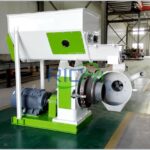
An automatic animal feed pellet machine can help control material flow and reduce repetitive manual operations during the pelleting process. However, automation should be combined with suitable raw material preparation and machine configuration.
Cattle Feed Has Different Material Characteristics
A cattle feed pellet mill machine may process formulas with a higher proportion of forage or fibrous materials than some poultry feed formulas.
Fibrous ingredients can influence material flow and feeding performance. If the material does not enter the pelletizing chamber consistently, production can fluctuate.
For this reason, the feeding system should be selected according to the formula. Forced feeding and suitable anti-bridging arrangements can be useful when materials have poor flow characteristics.
Grinding Before Pelleting
The production process begins with raw material preparation. Grain ingredients may need to be ground before they are mixed with other components.
The desired particle size depends on the formula and pellet requirements. Excessively coarse material can make pellet formation more difficult, while excessively fine grinding may increase energy use without providing additional practical benefits.
The objective is to achieve a particle size that supports efficient mixing and stable pellet production.
Automatic Batching and Mixing
Cattle feed may contain several ingredients in different proportions. Automatic weighing and batching can improve consistency when multiple formulas are manufactured.
After batching, the ingredients are mixed until they are evenly distributed. Consistent mixing is important because the nutritional composition should remain stable from one batch to another.
Automation can reduce manual weighing errors and make formula management easier, particularly in commercial plants.
Controlled Conditioning
Before pelleting, the mash can pass through a conditioner where steam is introduced. The conditioning process prepares the material for compression.
Automatic monitoring can help operators observe temperature and other process conditions. This is useful because changes in raw material moisture or formula composition can influence the required conditioning settings.
The purpose is not simply to increase temperature but to prepare the material consistently for pellet formation.
Automatic Feeding Into the Pellet Mill
Feeding control is one of the most useful functions of automation. The feeder should supply the conditioner and pellet mill at a stable rate.
If the feed rate changes significantly, motor load and production output can also change. An automatic system can adjust feeding according to programmed conditions and operator settings.
This can be especially valuable in commercial cattle feed production where continuous operation is expected.
Cooling and Final Handling
Fresh cattle feed pellets need to be cooled after pelleting. The cooler reduces pellet temperature and helps prepare the product for screening and storage.
Screening can remove fines and separate the finished pellets from unwanted particles. If the feed requires a smaller particle size, a crumbler can be added after cooling.
The packing system should then be matched with the production capacity so that finished feed does not accumulate.
Monitoring and Maintenance
Automation does not eliminate maintenance. Operators still need to inspect dies, rollers, bearings, feeders, conveyors, and other components.
Automatic monitoring can actually make maintenance more systematic by providing information about motor load, temperature, and machine status.
Operators should investigate changes in vibration, unusual noise, feeding behavior, and pellet appearance rather than waiting for equipment failure.
Manufacturers can look here to compare different equipment configurations and understand how automation is incorporated into feed production.
Richi Machinery provides feed processing equipment for different animal and livestock feed applications. Equipment selection can be adapted to the raw materials, capacity, pellet diameter, and desired automation level.
Is Full Automation Necessary?
Not every cattle feed producer needs a fully automated factory. A smaller operation may only require controlled feeding and basic electrical control, while a large commercial facility may benefit from automated batching, conveying, pelleting, cooling, screening, and packing.
The appropriate level of automation should therefore be determined by production scale and labor requirements.
When correctly applied, automation can make cattle feed production more consistent and easier to monitor. Combined with appropriate grinding, mixing, conditioning, pelletizing, and cooling equipment, it creates a more controlled production environment and provides a practical foundation for long-term feed manufacturing.
view details: https://www.richimanufacture.com/animal-feed-pellet-machine-for-sale/