Chicken feed production is a cost-sensitive business in which even a small improvement in production efficiency can have a meaningful impact on the cost of every ton of finished feed. Feed manufacturers and poultry farms need to control not only raw material expenses but also labor, electricity, maintenance, pellet losses, storage losses, and production downtime.
Modern technology provides new ways to manage these costs. Instead of relying on manual operation and individual machines, modern chicken feed factories can integrate grinding, batching, mixing, conditioning, pelletizing, cooling, screening, and packaging into a coordinated production system.
Automation is particularly important because it allows manufacturers to control production parameters more accurately. Automatic batching can reduce formulation errors, variable-frequency drives can regulate material flow, advanced conditioning systems can improve pelletizing performance, and automated monitoring can identify equipment problems before they cause major downtime.
A modern chicken feed production line can therefore reduce costs not by relying on a single piece of equipment, but by improving the efficiency of the entire production process.
When investors compare chicken feed pellet machine price, they should also consider the machine’s capacity, energy consumption, durability, maintenance requirements, automation level, pellet quality, and expected operating life. The cheapest machine at the purchasing stage is not necessarily the machine that produces feed at the lowest long-term cost.
This article explores how modern technology reduces chicken feed production costs and what factors feed manufacturers should consider when designing an efficient poultry feed production line.
Understanding the Main Costs of Chicken Feed Production
Before discussing technology, it is important to understand where production costs come from.
A typical chicken feed manufacturing operation may have expenses related to:
- Raw materials
- Electricity
- Steam or fuel
- Labor
- Equipment maintenance
- Spare parts
- Packaging
- Material handling
- Dust collection
- Storage
- Product losses
- Equipment downtime
- Quality control
Raw materials normally represent a major part of total feed cost, but other operating expenses can also become significant as production capacity increases.
For example, a small difference in electricity consumption per ton may seem insignificant for a small farm. However, at a commercial plant producing tens or hundreds of tons per day, the cumulative energy cost can become substantial.
Modern technology focuses on reducing these costs through better control, higher efficiency, and lower material losses.
Automatic Batching Reduces Formula Errors
One of the first opportunities to reduce production costs is accurate batching.
Chicken feed formulas often contain several major ingredients and small quantities of vitamins, minerals, amino acids, and other additives.
Manual weighing can create inconsistencies. If the actual quantity of an ingredient differs from the formulated quantity, the manufacturer may face several problems.
These can include:
- Nutritional inconsistency
- Material waste
- Formula correction costs
- Poor feed quality
- Batch rejection
- Increased labor requirements
Automatic batching systems use weighing equipment and programmed formulas to control ingredient quantities.
The system can store multiple recipes and automatically dose each ingredient according to the selected formula.
This improves accuracy and reduces the amount of material lost because of incorrect weighing.
Automatic Formula Management Improves Production Efficiency
Modern feed factories may produce several types of chicken feed, including:
- Chick starter feed
- Broiler starter feed
- Broiler grower feed
- Broiler finisher feed
- Layer feed
- Breeder feed
Each formula can contain different proportions of corn, soybean meal, wheat bran, rice bran, minerals, oil, and other ingredients.
An automated control system allows operators to select a stored formula rather than manually recalculating ingredient quantities for every batch.
This reduces setup time and makes formula switching more efficient.
For large feed factories, the ability to manage multiple recipes through a centralized control system can reduce both labor requirements and production errors.
Efficient Grinding Can Reduce Energy Consumption
Grinding is an important stage in chicken feed production.
Raw materials such as corn and wheat usually need to be processed to achieve a suitable particle size before mixing and pelletizing.
However, grinding too finely can increase electricity consumption without necessarily improving feed quality.
Modern grinding systems can use appropriate screen sizes, hammer configurations, feeding systems, and motor controls to achieve the required particle size efficiently.
The objective is not simply to produce the smallest possible particles.
Instead, the goal is to achieve the appropriate particle size for the formula while minimizing unnecessary energy consumption.
Particle Size Affects Pelletizing Costs
Particle size can also influence pellet mill performance.
If particles are too large, the material may be more difficult to compress uniformly.
If particles are excessively fine, grinding energy consumption can increase and the material may create additional dust.
A suitable particle size can improve:
- Mixing uniformity
- Conditioning efficiency
- Pellet formation
- Pellet durability
- Production stability
Therefore, optimizing grinding can reduce costs indirectly by improving the performance of downstream equipment.
Accurate Mixing Reduces Material Waste
Mixing is another stage where modern technology can improve efficiency.
The purpose of mixing is to distribute all ingredients evenly throughout the feed.
An advanced mixer can achieve uniformity within a controlled mixing time.
Automation can control the loading sequence, mixing time, liquid addition, and discharge.
This reduces the risk of under-mixing or excessive mixing.
A well-controlled mixing process can also reduce the need for repeated processing caused by inconsistent batches.
Modern Conditioning Improves Pelletizing Efficiency
Steam conditioning is one of the most important technologies in modern chicken feed pellet production.
During conditioning, steam increases the temperature and moisture of the feed mixture.
This can improve material plasticity and binding characteristics before pelletizing.
Proper conditioning can help the pellet mill produce stronger pellets while maintaining stable production.
Poor conditioning may result in:
- Increased power consumption
- Lower pellet durability
- Higher fines
- Unstable production
- Increased die pressure
By controlling temperature, moisture, steam flow, and conditioning time, modern systems can create more stable conditions for pelletizing.
Efficient Pelletizing Reduces Cost Per Ton
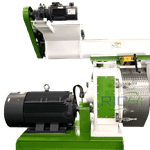
The pellet mill is one of the core machines in a chicken feed production line.
A modern chicken feed pellet mill should be selected according to:
- Required capacity
- Feed formula
- Pellet diameter
- Raw material characteristics
- Motor power
- Die configuration
- Automation requirements
- Expected operating hours
The goal is to produce the required quantity of pellets while maintaining stable quality and reasonable energy consumption.
A machine that produces a high output but consumes excessive electricity may not provide the lowest cost per ton.
Therefore, production efficiency should be evaluated using total operating cost rather than output alone.
(Learn more:https://richipelletizer.com/chicken-feed-pellet-machine-for-sale/)
Looking Beyond Chicken Feed Pellet Machine Price
When purchasing equipment, many investors initially focus on chicken feed pellet machine price.
Price is certainly an important consideration, but it should not be the only factor.
A proper equipment comparison should also consider:
- Production capacity
- Motor efficiency
- Pellet quality
- Die and roller durability
- Maintenance frequency
- Spare parts availability
- Automation level
- Safety features
- Expected service life
- After-sales support
For example, Machine A may have a lower purchase price than Machine B, but if Machine B has higher throughput, lower energy consumption, longer-lasting wear parts, and fewer production interruptions, its total cost of ownership may be lower.
This is why feed manufacturers should compare both initial investment and long-term operating costs.
Variable-Frequency Drives Improve Process Control
Variable-frequency drives are widely used in modern feed production systems.
They can control the speed of motors used for:
- Feeders
- Conveyors
- Pellet mill feeders
- Fans
- Pumps
- Other auxiliary equipment
Instead of operating continuously at one fixed speed, equipment can operate according to actual production requirements.
For example, a pellet mill feeder can adjust the material flow according to motor load.
If the pellet mill approaches its maximum operating load, the feeding speed can be reduced.
If the load decreases, the feeding speed can be increased within the designed operating range.
This helps improve production stability and prevents unnecessary overloads.
Automatic Load Control Reduces Downtime
Pellet mills operate under heavy mechanical loads.
Sudden changes in material flow can cause overload conditions.
An automated load-control system can monitor motor current and adjust feeding accordingly.
This can help prevent:
- Motor overload
- Production interruptions
- Excessive die pressure
- Unstable pellet quality
- Mechanical stress
Reducing downtime is important because idle equipment still creates costs through labor, electricity for auxiliary systems, maintenance, and lost production opportunities.
Better Pellet Quality Reduces Fines
Pellet quality has a direct relationship with production cost.
If pellets have low durability, they may break during:
- Cooling
- Screening
- Conveying
- Packaging
- Transportation
- Storage
The result is more fines.
Fines may need to be recycled into the production process or may be sold at a lower value.
Modern pellet production technology focuses on maintaining suitable:
- Moisture
- Temperature
- Compression
- Die configuration
- Feed rate
- Conditioning
Better pellet durability can therefore reduce product losses.
Efficient Cooling Reduces Product Losses
Fresh pellets leave the pellet mill at elevated temperature and moisture.
They need to be cooled before storage or packaging.
An inefficient cooling system can result in:
- Excessive moisture
- Poor storage stability
- Pellet cracking
- Increased fines
- Higher energy consumption
Modern counterflow cooling systems and automated discharge controls can provide more stable cooling.
The objective is to remove heat and moisture efficiently without unnecessarily damaging the pellets.
Automated Screening Improves Product Recovery
Screening separates qualified pellets from fines and oversized particles.
An automated screening system can continuously classify the product.
Fines can often be returned to the pellet mill for reprocessing.
This improves material utilization.
If screening is poorly designed, excessive qualified pellets may be removed with the fines, resulting in unnecessary material recycling.
A properly selected screen can therefore improve both product quality and production efficiency.
Crumbling Technology Helps Reduce Feed Processing Costs
Young chickens may require crumbled feed rather than full-size pellets.
A pellet crumbler can process pellets into smaller particles after cooling.
Modern crumbling equipment can provide more consistent particle size while minimizing excessive fines.
This is particularly important for chick starter feed.
The system should be matched to the desired crumble size and production capacity.
Automation Reduces Labor Costs
Labor is another major production expense.
In a traditional feed mill, workers may need to manually control:
- Weighing
- Feeding
- Mixing
- Steam
- Pelletizing
- Cooling
- Screening
- Packaging
As capacity increases, manual operation becomes increasingly difficult.
Automation allows fewer operators to supervise more equipment.
A centralized control system can display machine status, production parameters, alarms, and operating data.
Workers can therefore spend more time on quality control, maintenance, and production management rather than repetitive manual tasks.
Centralized Control Improves Production Management
A modern control system can connect the major machines in a chicken feed production line.
The basic process may be:
Raw Material Receiving → Cleaning → Grinding → Batching → Mixing → Conditioning → Pelletizing → Cooling → Screening → Packaging
Instead of operating every machine separately, operators can monitor the entire process through a centralized interface.
This improves coordination between upstream and downstream equipment.
For example, if a downstream conveyor stops, upstream feeding equipment can also be stopped automatically to prevent material accumulation.
Data Monitoring Helps Identify Hidden Costs
Modern automation systems can collect production data.
Important data may include:
- Production volume
- Motor current
- Operating time
- Energy consumption
- Temperature
- Material flow
- Alarm frequency
- Equipment downtime
This information can help managers identify inefficiencies.
For example, if electricity consumption per ton gradually increases, the plant can investigate possible causes such as worn equipment, poor conditioning, blocked screens, or inefficient grinding.
Without production data, these problems may remain unnoticed.
Preventive Maintenance Reduces Repair Costs
Unexpected equipment failure can be expensive.
A broken bearing, damaged die, worn roller, or failed motor can stop production and require emergency maintenance.
Modern equipment management focuses on preventive maintenance.
Operators can monitor:
- Bearing temperature
- Motor load
- Vibration
- Lubrication
- Wear conditions
- Operating hours
Maintenance can then be scheduled before a component reaches a critical condition.
This can reduce emergency repairs and extend equipment service life.
Durable Wear Parts Reduce Long-Term Costs
Pellet dies and rollers are important wear components.
Their service life depends on:
- Material characteristics
- Production volume
- Pellet diameter
- Compression ratio
- Operating conditions
- Maintenance
Using suitable wear-resistant materials can increase service life.
Although high-quality components may increase initial equipment costs, they can reduce the frequency of replacement.
When evaluating chicken feed pellet equipment, manufacturers should therefore consider the total cost of wear parts over several years rather than comparing only the purchase price.
Energy-Efficient Motors Reduce Operating Expenses
Electricity can represent a significant operating cost in a commercial feed mill.
Major electrical loads include:
- Hammer mills
- Pellet mills
- Fans
- Conveyors
- Feeders
- Coolers
- Packaging equipment
Modern motors and drive systems can improve energy utilization.
However, energy efficiency should be evaluated across the entire system.
For example, if the pellet mill is efficient but the grinding system is oversized and operates inefficiently, the overall production cost may still be high.
Dust Collection Improves Material Recovery
Dust is generated during:
- Raw material handling
- Grinding
- Mixing
- Screening
- Conveying
Modern dust collection systems can capture airborne particles and improve the working environment.
They can also reduce material losses caused by excessive dust escaping from the process.
A well-designed dust collection system should be integrated with the factory layout and material flow.
Packaging Automation Reduces Labor and Waste
Packaging is the final stage of many chicken feed production lines.
Manual weighing and bagging can require significant labor.
Automatic packing machines can control:
- Bag filling
- Weighing
- Bag clamping
- Sewing or sealing
- Conveying
Accurate weighing also helps reduce product giveaway.
If every bag contains slightly more feed than required, the cumulative loss can become significant at high production volumes.
Automated packaging helps maintain more consistent filling weights.
Better Factory Layout Reduces Material Handling Costs
Technology can also reduce costs through better plant design.
An efficient layout minimizes unnecessary movement of raw materials and finished products.
Equipment should be arranged according to the production sequence.
For example:
Raw Material Storage → Grinding → Batching → Mixing → Pelletizing → Cooling → Screening → Packing → Finished Product Storage
Shorter conveying distances can reduce energy consumption and simplify maintenance.
Vertical layouts can also be used where appropriate to take advantage of gravity and reduce horizontal conveying requirements.
Complete Production Lines Can Improve Cost Control
Purchasing individual machines without considering the complete process can create inefficiencies.
For example, installing a high-capacity pellet mill without sufficient cooling or screening capacity can create a bottleneck.
Similarly, a high-capacity grinder does not necessarily improve total production if the batching or mixing system cannot handle the material flow.
A complete production-line design considers the capacity balance between:
- Grinding
- Batching
- Mixing
- Conditioning
- Pelletizing
- Cooling
- Screening
- Packaging
Balanced equipment improves overall utilization and reduces bottlenecks.
How Technology Reduces Cost Per Ton
The ultimate goal is not simply to reduce the purchase price of equipment.
The goal is to reduce the cost of producing each ton of finished chicken feed.
A simplified cost structure can include:
Cost per Ton = Raw Material Cost + Energy Cost + Labor Cost + Maintenance Cost + Packaging Cost + Production Losses
Modern technology can influence nearly every part of this equation.
Accurate batching reduces material losses.
Efficient grinding reduces electricity consumption.
Stable conditioning improves pelletizing efficiency.
Modern pellet mills improve throughput.
Automation reduces labor requirements.
Preventive maintenance reduces repair costs.
Better cooling and screening reduce product losses.
Automated packaging reduces weighing errors.
When these improvements are combined, the overall cost per ton can be reduced.
How to Evaluate a Chicken Feed Pellet Machine Investment
When evaluating equipment, investors should ask several questions instead of focusing only on chicken feed pellet machine price.
What Is the Actual Capacity?
Nominal capacity should be compared with the expected production requirement.
How Much Power Does the Machine Consume?
Electricity consumption can significantly affect long-term operating costs.
What Is the Expected Service Life?
Durable equipment may have a higher initial price but lower replacement costs.
How Often Do Wear Parts Need Replacement?
Die and roller costs should be included in the long-term calculation.
What Level of Automation Is Included?
Automation can affect labor requirements and production stability.
Can the Machine Handle Different Formulas?
Flexibility is important for feed factories producing multiple products.
Is Technical Support Available?
Installation, commissioning, operator training, and after-sales service can influence the long-term performance of the equipment.
(investigate this site:RICHI Pelletizer)
Initial Investment vs Total Cost of Ownership
A common mistake is to compare equipment solely by purchase price.
A more useful approach is to calculate total cost of ownership.
This may include:
- Initial equipment investment
- Installation
- Electrical systems
- Spare parts
- Energy consumption
- Labor
- Maintenance
- Wear parts
- Downtime
- Equipment replacement
For example, a pellet mill with a lower initial price may require more frequent maintenance or consume more electricity.
Another machine may have a higher purchase price but operate more efficiently for many years.
Therefore, the better investment decision should be based on the expected cost over the equipment’s operating life.
Modern Technology Also Supports Future Expansion
A feed production line should not only meet today’s requirements.
Poultry feed demand may increase in the future, and manufacturers may add new products or increase production capacity.
An automated control system and modular production-line design can make future upgrades easier.
Potential expansion may include:
- Additional batching bins
- Larger storage systems
- Additional pellet mills
- More packaging machines
- Advanced liquid addition
- Additional cooling capacity
- Expanded automation
Planning for future expansion can prevent manufacturers from having to replace an entire production system later.
Why Process Optimization Matters More Than One Machine
Modern technology should be viewed as a complete production strategy.
A highly efficient pellet mill cannot compensate for poor raw material preparation.
Likewise, accurate batching cannot compensate for inadequate mixing or poor conditioning.
Cost reduction comes from optimizing the entire process.
The most important stages include:
Raw Material Management
Ensures appropriate quality and minimizes waste.
Grinding
Produces suitable particle size with reasonable energy consumption.
Batching
Ensures accurate ingredient proportions.
Mixing
Creates a uniform feed mixture.
Conditioning
Provides appropriate heat and moisture before pelletizing.
Pelletizing
Converts the conditioned mixture into stable pellets.
Cooling
Reduces temperature and moisture.
Screening
Removes fines and improves product uniformity.
Packaging
Provides accurate finished-product weights.
Conclusion
Modern technology can reduce chicken feed production costs in many ways. The biggest savings do not necessarily come from purchasing the cheapest equipment. Instead, they come from improving the efficiency and reliability of the entire production process.
Automatic batching can reduce formulation errors. Efficient grinding can control energy consumption. Advanced conditioning can improve pelletizing performance. Modern pellet mills can increase output and maintain stable pellet quality. Automated cooling and screening can reduce product losses, while centralized control systems can reduce labor requirements and improve production monitoring.
When comparing chicken feed pellet machine price, manufacturers should therefore consider the complete cost of ownership rather than looking only at the initial quotation. Capacity, energy consumption, durability, maintenance, wear-part life, automation, pellet quality, and after-sales support can all influence the actual cost of producing chicken feed.
For a modern poultry feed factory, the best production technology is the one that matches the feed formulas, raw materials, capacity requirements, labor conditions, and future expansion plans.
With a properly designed production line and suitable automation, manufacturers can control production costs more effectively, reduce waste, improve equipment utilization, and establish a more stable foundation for long-term chicken feed production.