Premixes are an important part of modern animal nutrition. Although they are used in relatively small quantities compared with major feed ingredients such as corn, wheat bran, soybean meal, and other protein sources, they can have a significant influence on the nutritional consistency of the final diet. Vitamins, minerals, amino acids, enzymes, and other functional additives need to be distributed evenly so that animals receive a more consistent supply of essential nutrients.
For this reason, producing premix is not simply a matter of putting several additives into a mixer. The selection of raw materials, particle size, weighing accuracy, mixing uniformity, storage conditions, and production sequence all affect the quality of the finished product. For businesses considering a new facility, understanding these factors is useful before choosing equipment or deciding on production capacity.
What Is a Premix Feed Mill?
A premix feed mill is a specialized facility designed to accurately weigh, dose, mix, and sometimes package concentrated nutritional ingredients used in animal feed formulations. Unlike a conventional feed plant that handles large quantities of grains and protein meals, a premix facility usually works with smaller amounts of highly concentrated ingredients.
A typical premix formulation may contain vitamin products, mineral sources, amino acids, trace elements, enzymes, antioxidants, carriers, and other nutritional additives. The exact formulation depends on the target animal, growth stage, production purpose, and nutritional requirements.
Because some ingredients are included at very low inclusion rates, production accuracy is particularly important. A small weighing error can have a much greater effect when the ingredient is highly concentrated. This is one reason why premix manufacturing often requires more precise dosing and process control than ordinary bulk feed production.
Why Is Premix Production More Sensitive to Accuracy?
One of the main challenges in premix manufacturing is that different ingredients can vary considerably in density, particle size, flowability, and inclusion rate.
For example, a formulation may contain a large quantity of carrier material together with relatively small amounts of vitamins, minerals, or amino acids. If these components are not properly dosed and mixed, the nutritional concentration may vary from one portion of the batch to another.
This creates two technical requirements.
First, the weighing system must be capable of handling both relatively large and very small quantities accurately. Second, the mixing process must achieve sufficient uniformity without causing excessive segregation after mixing.
The objective is not simply to produce a visually homogeneous powder. The finished mixture needs to maintain an appropriate distribution of active ingredients throughout the batch and during subsequent handling.
Which Raw Materials Are Commonly Used?
Raw materials for premix production can generally be divided into several groups.
Vitamins are used to support normal physiological functions and may include vitamin A, D, E, K, and various B vitamins. Their inclusion rates depend on the formulation and animal species.
Minerals can include calcium, phosphorus, zinc, iron, copper, manganese, selenium, and other mineral sources. These ingredients may be supplied in different chemical forms and particle sizes.
Amino acids such as lysine, methionine, threonine, and tryptophan are frequently used when nutritional formulations require additional amino acid supplementation.
Functional additives may include enzymes, antioxidants, acidifiers, probiotics, or other specialty ingredients, depending on the intended feed application and local regulatory requirements.
Carriers or diluents are also important in many premix formulations. They help distribute low-inclusion ingredients throughout the mixture and improve handling characteristics.
The choice of carrier should not be treated as an afterthought. Its particle size, moisture content, density, and flowability can influence the behavior of the entire mixture.
How Should Premix Ingredients Be Prepared?
Raw material preparation begins before the ingredients reach the mixer. Incoming materials should be inspected and stored according to their physical and nutritional characteristics.
Powdered ingredients may require screening to remove foreign materials or agglomerates. Some materials may need grinding or other size-reduction processes if their particle size is unsuitable for accurate mixing.
However, not every ingredient should automatically be ground. Excessive grinding can increase energy consumption, generate dust, and sometimes create undesirable differences in particle size. The appropriate preparation method depends on the material and formulation.
Moisture control is another consideration. High moisture can affect flowability, storage stability, and mixing performance. Hygroscopic ingredients may require additional attention because they can absorb moisture from the surrounding environment.
What Does the Production Process Usually Include?
Although plant layouts vary according to capacity and formulation, a typical process can be organized into several stages:
- Raw material receiving
- Storage and identification
- Screening or preparation
- Accurate weighing and batching
- Premixing of micro-ingredients
- Main mixing
- Temporary storage or buffer handling
- Quality inspection
- Packing and finished-product storage
The actual configuration depends on the number of raw materials, production capacity, formulation complexity, and required automation level.
For smaller facilities, some stages may be combined. Larger plants may use multiple storage bins, automatic dosing systems, separate micro-dosing units, and centralized control systems.
Is a Micro-Dosing System Necessary?
This is one of the most important questions when designing a premix facility.
A conventional weighing system may work well for ingredients used in relatively large quantities. However, when a formulation includes ingredients with very low inclusion rates, manually measuring them can create inconsistency and increase labor requirements.
A micro-dosing system is designed specifically for these small quantities. It can use smaller hoppers, more sensitive weighing components, and dedicated feeding mechanisms to improve dosing accuracy.
Whether such a system is necessary depends on the formulation and production scale. A small operation with a limited number of formulations may use semi-automatic methods, while a larger facility producing multiple formulas may benefit from a more automated dosing architecture.
The key is to match the dosing equipment with the smallest practical ingredient quantity rather than choosing equipment based only on the total batch size.
Why Is Premixing Sometimes Used Before Main Mixing?
Very small quantities of additives can be difficult to distribute evenly when they are added directly to a large batch.
For this reason, manufacturers may first prepare a smaller intermediate mixture. A small amount of carrier is combined with micro-ingredients to create a more evenly distributed intermediate premix. This material can then be added to the main batch.
The approach is similar to gradually diluting a concentrated ingredient before incorporating it into a much larger mixture.
Premixing can therefore improve distribution and reduce the risk of localized concentration. It is particularly useful when formulations contain multiple micro-ingredients with very low inclusion rates.
The exact procedure should be established through formulation trials and mixing tests rather than assuming that one premixing ratio is suitable for every product.
How Do You Choose the Right Mixer?
Mixer selection is closely related to product characteristics.
A good mixer for premix production should provide consistent distribution within a reasonable mixing time while minimizing segregation. Depending on the formulation, manufacturers may consider horizontal ribbon mixers, paddle mixers, or other specialized powder mixing equipment.
Important parameters include batch size, mixing time, filling ratio, particle characteristics, moisture level, and the type of ingredients being processed.
It is also important to consider the discharge behavior of the mixer. If a significant amount of material remains inside the equipment after discharge, cross-contamination between different formulas can become a concern.
Therefore, equipment selection should consider not only mixing uniformity but also cleaning, discharge efficiency, maintenance, and production changeover.
How Can Cross-Contamination Be Reduced?
Premix facilities may manufacture many different formulas, which makes cross-contamination an important operational issue.
One practical approach is to establish an appropriate production sequence. Products with certain characteristics can be scheduled in an order that reduces the risk of contaminating subsequent batches.
Equipment design also matters. Smooth internal surfaces, efficient discharge, accessible inspection points, and suitable cleaning procedures can simplify sanitation.
Separate storage and dosing systems may be considered for ingredients that require special handling. The need for segregation depends on the formulation, local regulations, and the manufacturer’s quality management system.
In automated facilities, production software can also help manage formulas, batching sequences, ingredient identification, and production records.
What Equipment Is Usually Included?
The equipment configuration of a premix facility depends heavily on production requirements.
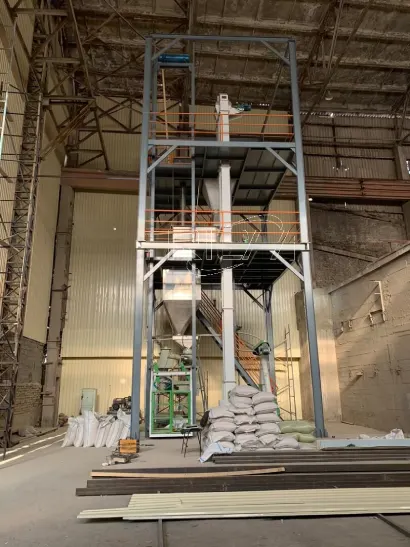
A relatively complete system may include raw material storage bins, bag dumping stations, sieves, conveying equipment, micro-dosing units, weighing systems, mixers, dust collection equipment, finished-product bins, and packing machines.
For powder products, dust control deserves particular attention. Many vitamin and mineral ingredients are fine powders, and uncontrolled dust can affect the working environment, material recovery, and equipment cleanliness.
Bag filters or other dust collection systems can be incorporated at material transfer points and around the weighing and mixing areas.
Packaging equipment can also be configured according to the product format. Premixes may be packed into small bags, medium-size sacks, or bulk containers depending on customer requirements.
How Large Should a Premix Plant Be?
There is no universal production capacity suitable for every project.
A small commercial operation may require a relatively modest batching system, particularly if it serves a limited local market. A larger manufacturer supplying multiple feed mills may require several mixing lines and automated ingredient handling.
Capacity should be calculated from actual demand rather than simply selecting the largest available equipment.
For example, if the target production is 1 ton per hour, the design should consider batch size, mixing time, weighing time, discharge time, cleaning intervals, and working hours. A nominal mixer capacity does not automatically equal actual hourly output.
A practical capacity calculation should therefore include the entire production cycle.
Does a Premix Plant Need Full Automation?
Automation can improve consistency and reduce manual handling, but full automation is not always necessary.
A semi-automatic plant may be suitable when production volume is limited and the number of formulations is relatively small. Operators can manually handle selected micro-ingredients while larger-volume materials are automatically weighed.
For larger plants, automated batching can reduce repetitive manual work and provide better production traceability. Formula management software can also help ensure that the correct quantities are used for each batch.
When evaluating automation, manufacturers should consider labor costs, production volume, formulation complexity, required accuracy, and future expansion plans.
A well-designed semi-automatic system can sometimes be more practical than installing unnecessary automation from the beginning.
What Is the Typical Construction Process?
Building a premix facility normally starts with process planning rather than equipment purchasing.
The first step is to define the products to be manufactured, including their formulations, ingredient quantities, packaging formats, and expected production volume.
The second step is process design. Engineers determine how raw materials will move from receiving and storage through weighing, mixing, inspection, and packaging.
The third step is equipment selection. Equipment specifications should be based on the process requirements rather than simply choosing machines according to their advertised capacity.
After equipment manufacturing and delivery, installation and commissioning follow. Electrical systems, control systems, conveying lines, dust collection, and weighing equipment need to work together as an integrated process.
Finally, trial production is carried out to verify batching accuracy, mixing uniformity, discharge performance, and production efficiency.
How Long Does Plant Construction Take?
Construction time varies considerably from one project to another.
A small facility with relatively simple equipment may be installed within a comparatively short period, especially when the building is already available. A larger automated plant may require more time because of civil construction, equipment fabrication, electrical installation, control-system integration, and commissioning.
The project schedule should therefore be divided into several stages instead of using one fixed construction period.
These stages may include process design, layout confirmation, equipment manufacturing, transportation, foundation preparation, installation, electrical work, commissioning, and operator training.
Planning these activities in parallel where practical can help reduce unnecessary delays.
What Quality Checks Should Be Performed?
Quality control should cover both raw materials and finished premix.
Incoming ingredients should be checked for identity, appearance, moisture, packaging condition, and other relevant specifications. Depending on the ingredient and regulatory requirements, laboratory analysis may also be required.
During production, operators can monitor weighing records, batch numbers, mixing time, and equipment performance.
Finished products may be tested for nutrient concentrations, moisture, particle characteristics, and mixing uniformity according to the applicable product specifications.
Traceability is particularly valuable. Each batch should be associated with its formulation, raw material lots, production time, and quality-control records whenever practical.
This information can help manufacturers investigate inconsistencies and maintain more reliable production records.
How Should Premix Products Be Stored?
Storage conditions can affect product stability after production.
Many premix ingredients are sensitive to moisture, temperature, light, or prolonged exposure to air. Finished products should therefore be stored in clean, dry areas under conditions appropriate for the formulation.
Packaging should provide sufficient protection against moisture and contamination. Bags should be properly sealed and clearly labeled with product information, batch numbers, production dates, and other required details.
Stock rotation is also important. A first-in, first-out or another appropriate inventory system can help reduce unnecessary storage time.
Storage design should also prevent raw materials and finished products from becoming mixed or incorrectly identified.
What Should Be Considered When Buying Equipment?
Equipment price is only one part of the investment decision.
Buyers should consider weighing accuracy, mixer performance, production capacity, cleaning requirements, spare parts, electrical compatibility, dust control, automation level, and after-sales technical support.
It is also useful to ask whether the equipment can handle the actual raw materials used in the formulation. Two ingredients with similar names may have very different physical characteristics.
For businesses planning expansion, modular equipment can be useful. A system designed with additional storage, dosing, or mixing capacity in mind may make future upgrades easier.
Companies evaluating suppliers such as pelleting machine may also compare the proposed process flow, equipment configuration, automation level, and project support rather than focusing solely on individual machine prices.
Can a Small Facility Be Expanded Later?
Expansion is easier when it is considered during the initial design.
For example, the plant layout can reserve space for additional ingredient bins, another mixer, expanded packaging capacity, or upgraded conveying systems. Electrical distribution and control architecture can also be planned with future requirements in mind.
However, expansion should not mean installing oversized equipment from the beginning. Excess capacity can increase initial investment and leave equipment operating below its practical range.
A phased development strategy may be more appropriate for businesses whose market demand is still developing.
What Makes a Practical Premix Production Project?
A practical project balances several factors rather than maximizing a single parameter.
The formulation determines the raw materials. Raw material characteristics influence the dosing and mixing system. The desired capacity determines the number and size of machines. Product variety affects storage and cleaning requirements. Packaging specifications influence the final section of the production line.
These elements need to work together.
For example, a high-capacity mixer may appear attractive, but if the dosing system cannot accurately handle low-inclusion ingredients, the overall production process may still have limitations. Similarly, highly automated equipment may not be economically appropriate for a small facility with only a few formulas.
The best plant design is therefore usually the one that matches the actual production model.
Related Post:https://commercialpelletmill.com/poultry-feed-plant-price/
Final Thoughts
Premix manufacturing combines nutrition, material handling, weighing technology, mixing engineering, quality control, and production management. The small inclusion rate of many active ingredients makes accuracy particularly important, while differences in density and particle size create additional challenges for mixing and handling.
Before investing in a new facility, it is useful to define the target products, formulations, raw materials, production capacity, packaging formats, and expected expansion plans. These details provide the foundation for choosing suitable equipment and developing a practical process layout.
Whether the project is a small semi-automatic operation or a larger automated facility, careful process planning can help create a system that is easier to operate, maintain, and expand. Understanding these fundamentals also makes it easier to communicate technical requirements with equipment manufacturers and engineering companies before a project begins.