A 1–3 tons per hour rice husk pellet project can be suitable for rice mills, biomass fuel suppliers, and businesses with a steady supply of rice husk.
At this production scale, the system needs to maintain a stable material flow from raw material feeding through pelletizing, cooling, screening, and storage.
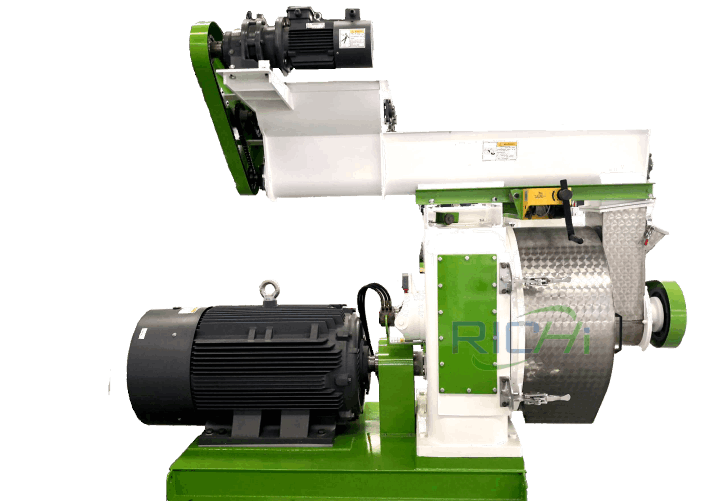
The rice husk pellet machine 1-3 tph should therefore be selected according to the actual raw material condition and required production capacity rather than output alone.
Raw Material Preparation
Rice husk is generated during rice milling and is generally available in large quantities near rice-processing facilities.
Before pelletizing, the material should be checked for moisture, impurities, particle size, and storage conditions.
Clean and relatively dry rice husk may require only limited preparation. If the material contains foreign matter or unsuitable particles, additional cleaning, crushing, or grinding equipment may be necessary.
The objective is to provide the pellet mill with a consistent feedstock.
Moisture Control
Moisture has a direct effect on pellet formation.
If rice husk is already within a suitable moisture range, it may be possible to send it directly to the grinding or pelletizing section. When the material is too wet, a drying system should normally be considered.
A rotary dryer can continuously reduce moisture before pelletizing. The dryer capacity should be matched with the 1–3 TPH production requirement so that it does not restrict the output of the pellet mill.
The actual drying requirement should be determined from raw material testing.
Grinding
Rice husk may need to be processed into a more consistent particle size before entering the pellet mill.
A hammer mill can reduce and homogenize the material when necessary.
Consistent particle size helps improve feeding and supports more stable compression inside the pellet mill.
The grinding section should also have sufficient capacity to continuously supply the pelletizing section.
Pelletizing Process
After preparation, the rice husk enters the pellet mill.
Inside the machine, rollers compress the biomass against a die. The material is forced through the die holes and forms cylindrical pellets.
Pellet diameter can be adjusted by selecting a suitable die.
The actual output of a 1–3 TPH system depends on raw material moisture, particle size, pellet diameter, equipment configuration, and operating conditions.
For comparison, a peanut shell pellet machine 1-3 tph can be used for another agricultural residue at a similar capacity range. However, peanut shells and rice husk have different physical properties, so their preparation requirements may not be identical.
Cooling and Screening
Fresh pellets normally leave the pellet mill at an elevated temperature.
A cooler can reduce the pellet temperature before storage or packing. This is particularly important for continuous production because finished pellets need to be transferred efficiently to the next stage.
After cooling, a screening machine separates fines and undersized pellets.
Depending on the system design, suitable fines can be returned to the pelletizing process.
Typical Equipment Configuration
A 1–3 TPH rice husk pellet project may include:
- Raw material feeding system
- Cleaning equipment when necessary
- Hammer mill
- Rotary dryer when required
- Pellet mill
- Pellet cooler
- Vibrating screen
- Conveyors
- Storage equipment
- Packing machine
The exact configuration depends on the condition of the rice husk.
A rice mill that already has clean and suitably dry material may not need every preparation machine listed above.
Material Conveying
Material handling becomes increasingly important as production capacity increases.
Conveyors can transfer rice husk between the grinding, drying, pelletizing, cooling, and screening sections.
A complete pellet production line can integrate these stages into one continuous production system. This reduces unnecessary manual material handling and helps each processing section work at a matched capacity.
The level of automation can be adjusted according to the customer’s operating requirements.
Storage and Packaging
Finished rice husk pellets should be protected from moisture during storage.
A bulk storage system may be suitable for industrial fuel users, while bagging equipment can be added when pellets are sold to smaller customers.
The required storage capacity depends on daily production, transportation arrangements, and delivery frequency.
These requirements should be considered during the initial plant design.
Key Information Before Purchase
Before selecting equipment, the project owner should prepare several basic details:
- Daily rice husk availability
- Initial moisture content
- Target production capacity
- Pellet diameter
- Existing equipment
- Available electricity
- Heat source for drying
- Storage requirements
- Packaging method
With this information, the equipment configuration can be designed around actual production conditions.
A 1–3 TPH rice husk pellet project is therefore an integrated process rather than simply a pellet mill installation. Proper preparation, moisture control, grinding, pelletizing, cooling, and screening all contribute to stable production.
For additional information about biomass pellet equipment and production planning, resource materials can also help when evaluating the complete project configuration.
Related Post: https://pelletizerequipment.com/corn-stalk-pellet-machine/